5 March 2026
This post first appeared in my 'On my mind' newsletter.
It is also available in Japanese.
Speak less. Sound more.
Most of us generate sound on a daily basis, by speaking or singing. We also talk about and refer to sound even when we don't think we are. It permeates our language from the positive through the contemplative to the outright hostile:
I like the sound of this.
Sounds familiar.
I'd like to sound them out.
Speak your mind.
I’m your sounding board.
I hear you.
A loudmouth.
Quiet as a mouse.
Sounds scary.
That's loud.
We go to eleven.
I'm in tune with that.
It doesn’t sound right.
I can’t find the words.
How does that sound to you?
Don't make a sound.
Our understanding of sound in all its shapes and forms helps us express activity and understanding, trigger emotion, and bring clarity. Every language and culture has its own version of them.
Still, unless we are musicians we rarely create sound outside of ourselves to use in our communication.
But we should.
Even if we're not musicians or audio engineers, the learning curve is small. We already process sound every waking minute of every day. It comes at us from all directions, 360°, unlike visual cues which we take in through a 120° field of view. We use our fingers to drum along to a favourite song. Let out an approving whistle when we hear about something amazing. Applaud. Sounds, all of it.
In the creative industries we can take it one step further and use sound as a method for feedback in everyday work scenarios.
When we remove the ability to express ourselves in spoken or written words we need to think harder to get our message across. And it's not difficult. Honestly it's not. We've understood and expressed ourselves through sound our whole lives. Audio feedback in a work environment is merely a new context for something we already do.
Below is an early concept sketch for a moving sculpture, part of a city project I was involved with. What if you were to share your impresson of it with the creators, using only sound? Not words or song, just sound. What would that sound be? A rumbling generated in a DAW, getting louder by the second? The recorded laughter of your child? A couple of chords on a guitar? Or the opening ten seconds of Iris by Goo Goo Dolls, which is what I used?
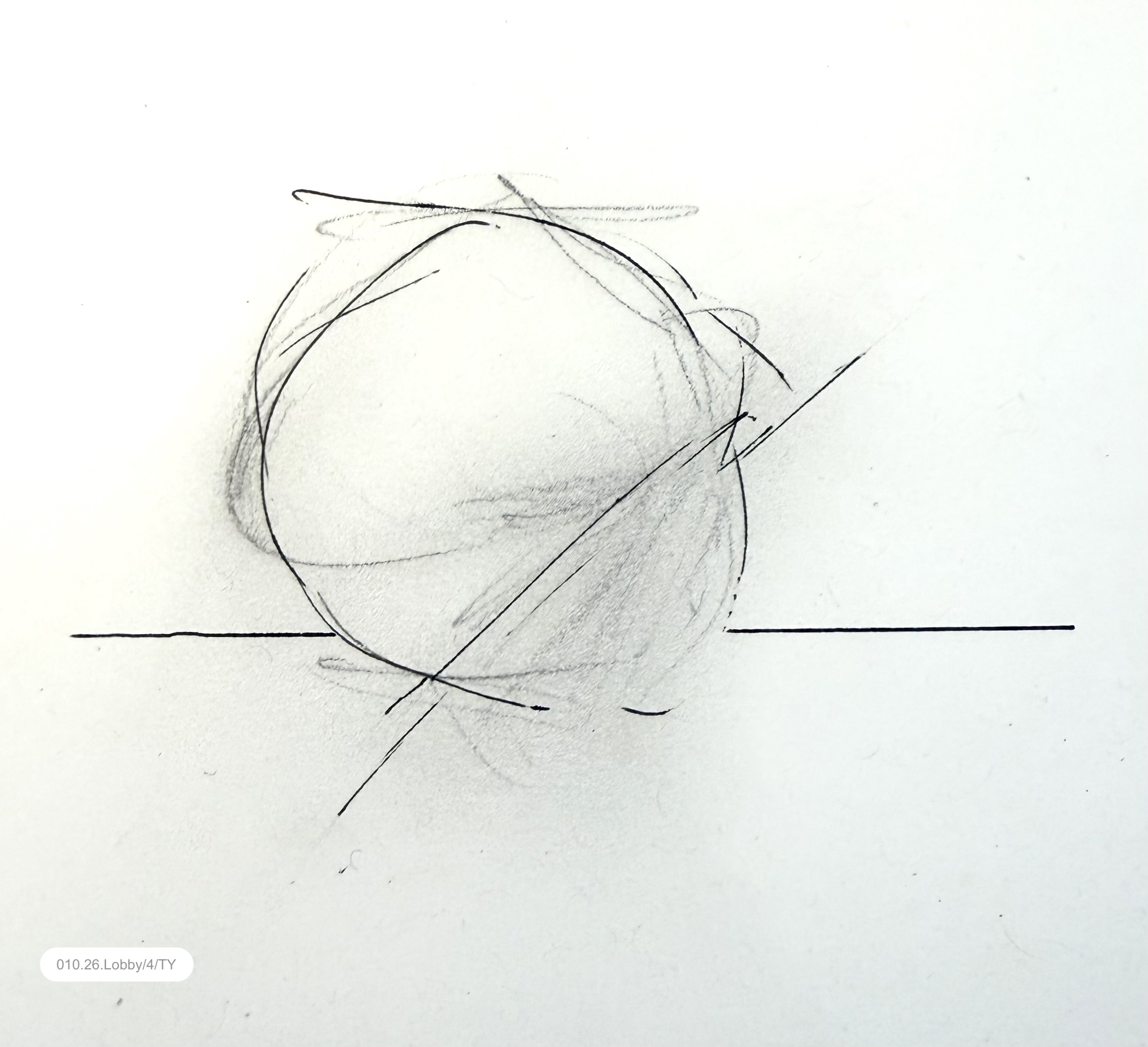
Either way, you'd give it quite a lot of thought. You'd make sure the sound conveyed exactly what you wanted to say. You’d re-edit it. Turn up the treble, shorten the release or re-record those forest sounds one more time. Or hunt for the right moment in a piece of music.
The benefits rack up quickly.
Feedback becomes more considered and thoughtful. Shared responsibility increases, creating sound to comment on someone else's creation brings a contextual transparency that words rarely achieve. The input becomes both more specific and more open to interpretation, which supports an iterative way of working. Clarity increases too, because it's almost impossible to hide behind caveats and arse-covering defenses in an audio note. And moving from merely hearing to listening creates a sense of satisfaction at every stage, for everyone involved.
There are downsides. It will feel awkward at first, but it passes. Unless sessions are recorded, it's hard to share results with those who weren't there. Hearing-impaired colleagues might seem at a disadvantage, though I've been proven wrong on that three times now so it's time for me to wise up.
Not every country is starting from the same place, whether between machines and people or human to human. My co-host on The All-design Podcast, Tokyo-based designer Mayu Nakamura, just last week pointed out how differently our two countries relate to audio as communication.
Japan is light-years ahead of Sweden in using sound to convey and even solicit input. The trustworthy jingle an ATM plays when dispensing or receiving cash. A Matsuzakaya department store shifting its soundscape, including elevator dings, depending on time of day and level of busyness. The musical signature of a train station confirming you're at the right stop. Purposefully created audio is part and parcel of everyday life.
If, like me, you are playing catch-up in this area just give it a go. You'll most likely let out a sigh of relief at how simple it is to create sounds for feedback (I use Garageband and Ferrite on my phone), and an appreciative whistle the first time you're on the receiving end of it.